Before I start, I’d like to say that this post – whilst contextually about politics – is not aimed to be inherently political, but I’m going to explain that context first so that you can hopefully see where I’m coming from. I’m also going to point out that this post isn’t necessarily going to prove anything or have some kind of Earth-shattering conclusion to it. It’s just something I found interesting and wanted to write about. With that in mind, let’s go.
In the UK, a scandal has hit involving Dominic Cummings, chief adviser to the Prime Minister, Boris Johnson. Mr Cummings is a very powerful man, and depending on who you believe, he is the person responsible for many of the policies that led the UK to Brexit and to Mr Johnson’s election in December, as well as its response to the COVID-19 pandemic.
The scandal, essentially, involves the fact that Mr Cummings drove his wife and child 260 miles from his London home to County Durham, while his wife was showing symptoms of the virus and after he himself had become exposed both through her, and through his work. To many, this contradicts the advice given by the British government, and it’s argued that his actions could have been illegal and risked the spread of the virus around the country.
On 25th May 2020, Mr Cummings gave a public press conference to defend his actions, something never done before by an adviser to any Prime Minister. It’s his statement at the beginning of the conference that I want to talk about, and one passage in particular. I’ll refer to it as ‘the Barnard Castle’ extract throughout the rest of this post. Here it is:

This is probably just me being a massive nerd, but I find this passage endlessly fascinating for a number of reasons, and I’m writing this post to talk about why it’s fascinating.
***
Words are not chosen by accident. In everything we say or write, no matter the language, our brains search our internal dictionaries to choose the correct vocabulary and grammar to express what we wish to say in the way that we wish to say it. In other words, our brains are subtext machines, whether know or not.
For example, there is not much inherent difference in the meanings of the sentences, “Can you open the window?” and “Could you open the window?” Native speakers and non-native speakers alike may point out that ‘could’ is slightly more formal, but why is it more formal? It’s quite simple – our brains look at the person we’re talking to. If we know them well or are their superior in the given context and perceive that they are likely to answer ‘yes’, we’ll use the can modal. If it’s a situation where we perhaps do not know the person so well, or are subservient to them in some way, or we’re not sure whether they’ll answer positively or negatively, we’ll use the could modal. The average native speaker does not know – or, frankly, need to know – that they are doing this. It’s not a conscious choice. Instead, it’s our brains choosing the appropriate language for the situation on an unconscious level.
Isn’t that just really really cool?!
So what does this have to do with Dominic Cummings?
The point I’m labouring towards is that we do not choose our words by accident, whether it’s conciously or subconciously. I think a bit of both applies in Mr Cummings’ statement.
***
I don’t think there are many people who would read the text of his statement and consider it to sound like ‘natural’ English, and they’d be correct. No native speaker – hell, the vast majority of non-native speakers above A1 level – speak or write like this.
I count 29 sentences in this extract, plus a handful more clauses, of which only four are not written in the past simple (subject+past verb) aspect, and there is almost no modality (words like ‘can’, ‘would’, ‘may’ etc.). There is also a surprising lack of adjectives and adverbs in this extract. These are, as any primary school kid or elementary-level EFL student who’s done their homework will be able to tell you, words that add detail to an object or action. They allow us to visualise how something looks or how it behaves, and especially in stories, this is important for retaining attention and getting your point across. Adding elements such as modality, a range of verb aspects and descriptive language helps stories to become more varied and less repetitive.
It’s been pointed out on Twitter that the language has been ‘legalised’; that only a lawyer could have written it to be so devoid of emotion and setting out purely the facts. I’m not an expert on legal English by any means, but I’ve seen enough suggesting this is the case that I’m confident it’s correct.
This poses another question, though. A large part of the defence of Cummings has been that he did what he did in order to care for his wife and child. Naturally, a very emotive subject that appeals to our maternal and paternal instincts. In that case, then, why would he – or a lawyer – strip this language to its bare bones in order to present it in the simplest, least emotive way possible?
I think it’s a good idea now to look not just at the grammar, but at the pronunciation of Mr Cummings during his statement. Words are just symbols, after all, which only truly becomes language on our tongues.
The first thing that struck me after listening to this back, after reading the transcript, is something slightly strange. Remember how I mentioned there were just a handful of clauses that aren’t past simple? Well, two of those examples are in the first two sentences. “15 days after I had first displayed symptoms” (past perfect: subject+had+past participle); “my eyesight seemed to have been affected” (a slightly unusual construction, but set around the present perfect passive: have/has+been+past participle). And those two passages happen to be the first time in the entire statement that Mr Cummings stumbles over his words when speaking. Is this a coincidence or a suggestion that he was entering a part of the statement that he was not familiar with and had not pre-rehearsed?
Something else I noticed. His intonation. The way in which he speaks. Many utterances in the early part of the statement feature rising intonation. In simple terms, this means that the pitch of his sentences ends at a higher point than it began, very often rising on the final word. This is particularly evident in some of the more emotive language that Mr Cummings uses early in the statement. For example:

This in itself isn’t super unusual. Lists of items have rising intonation after each item is uttered (try reading your shopping list, beginning with “I need”, and you’ll see what I mean), but in almost all situations, the final item on the list is given falling intonation instead. The pitch is lowered. Here, though, we hear rising intonation to the end of the list. This is unusual. A person would usually only do so in order to express a high level of emotion, which ties in here, I think. It’s a subconscious trigger to show the listener that he’s upset about the perceived threat on his home.
A couple more:
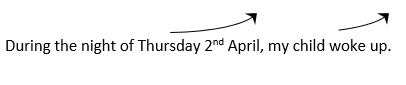
Note here that it’s more typical to have a two-clause sentence such as this one feature falling intonation on the second clause; here it rises.

In this utterance, we can make reference to the fact that the majority of statement sentences in English feature falling intonation. It’s pretty rare to have rising intonation in a statement as can be seen here. Unless you’re Australian, but that’s another story.
To me, all of this rising intonation in places where one may not expect to hear it gives the utterances more of an emotional punch. I don’t think it’s a coincidence that many of the utterances with rising intonation are those in which Mr Cummings is talking about his family. Again – he’s trying to relate to the listener’s base instincts and perhaps try to make them feel sorry for him. You’ll notice, too, that the sentences are more complex in terms of syntax (if not necessarily grammar) than the Barnard Castle extract.
And now let’s compare this with the Barnard Castle extract. In a major contrast to much of the earlier parts of the speech, with very few exceptions, his explanation about his trip to Barnard Castle and back to London features solely falling intonation.
That, in isolation, is nothing unusual. As I previously said, the majority of statements in English feature falling intonation – it’s just how the language is. But this is not in isolation. We compare it to the many instances of rising intonation in the early parts of the speech and the emotions that Mr Cummings is trying to tap into. We also combine the falling intonation with the short, simple sentences. And what we end up with is something almost robotic in its pronunciation. Sterile. Like a teenage actor in the school play who hasn’t bothered to read his lines and is standing centre stage holding the script.
I don’t think it’s a coincidence that the Barnard Castle extract remains the most contentious and debated section of Mr Cummings’ statement. If we look at the press conference and Mr Cummings’ speech objectively, the furore around his justification for driving to Durham seems to have cooled off a bit. Now, however, the internet and newspapers are alight with the revelation that Mr Cummings drove his family, with impaired eyesight, to a beauty location thirty minutes away from his residence, when the lockdown restrictions forbade unnecessary journeys.
In short, I think the language choices he made in the early parts of the statement were at least somewhat successful in his attempt to justify his actions. His speech patterns and sentence constructions suggest love and care of his family; relatable conditions. The trip to the castle, however, does not. Neither the description of his activities nor the emotionless way in which they were described were effective at convincing his audience that he did the right thing.
So why was this choice made? Why change the written and spoken style of this one section of a fifteen-minute speech? I have a couple of ideas, but note that these are just opinions based on my linguistic knowledge, and someone more familiar with the law and legal English (or even other linguists!) may not agree.
- Removing emotion places emphasis on the events. As Mr Cummings sees it, the truth. This happened. Then this happened. Then this happened. Constantly beginning sentences with a first-person pronoun (I, we) also accomplishes this. The lack of modals in the extract are one of the ways emotion can be removed. Modals come from the heart; they are our opinion and our viewpoint. Without them, we might as well be reading a recipe or following instructions.
- Continual past simple sentences obfuscate meaning. Generally, when we tell stories or anecdotes, we do our best to set the scene. Often this is through the use of the past continuous aspect (subject+was/were+ -ing verb), but adjectives also allow the listener to picture the scene in their minds. This is difficult to do when listening or reading this extract, possibly to purposefully make it harder to follow. A certain linguistic irony happens here, though – the past simple giving us events in order tricks us into thinking that the events do make sense. We must just have missed something because we were concentrating on trying to picture it in our minds.
- The emotional kick of the earlier part of the statement is a rebuke of the parts of the story that, to that point, had caused the most controversy. The idea of the trip to Durham at all, for any reason, was the thing the public could not stomach. This was justified in an emotional way and explained in great detail. Perhaps it was perceived – either by Mr Cummings or his legal advice – that the trip back to London was of lower importance, and thus the events could recounted more quickly and in a more sterile way. If this was their thinking, it has undoubtedly backfired.
- Conversely, perhaps it was perceived that the Barnard Castle section of the speech would be considered controversial. If they knew it would come across badly and had Mr Cummings attempted to create an emotional link through it, it might suggest to the listener that the actions described earlier in the speech were insincere, thus undermining the entire statement.
As I said right at the beginning, I’m very much not an expert on this stuff. I was watching the speech with interest, and it wasn’t until the following day that I read the transcript and saw the Barnard Castle extract on Twitter and became intrigued.
Ultimately, we can’t really know for sure what led to the choice of language in this part of the text, but it’s been very interesting to explore it. It’s really a fascinating piece of writing, I think. If anyone reading this draws a different conclusion to me, please do get in touch, as I’d be very interested to hear other perspectives.
Good lord, I’m such a nerd.
 Shane Rynhart
I have read this with great interest Shane. It’s exactly the kind of article that fascinates me as does your analysis. Well done I loved it!
LikeLiked by 1 person